BROOKINGS, Ore. (April 7, 2025) – A wide-open lingcod bite, with full limits over the weekend on our charter boats, has anglers anxiously awaiting the next nice-weather days on the Oregon Coast. The lingcod fishing is as good as it has been all year, with every customer on the Nauti-Lady, Miss Brooke and Papa B returning to port with their limit of lingcod on Saturday. The quality of the fish has been excellent, and the light-tackle, shallow-water action has been nothing short of epic.
Capt. Sam gaffs a lingcod aboard the Nauti-Lady in early April.
Lingcod remain in shallow water this time of year after the winter spawn. They are aggressive and hungry, attacking lures dropped onto the rocky crevices where they hide, waiting to ambush prey. Most of the fish are being caught in 20 to 40 feet of water, close to shore over rocky reefs. The lingcod are averaging 8 to 10 pounds, with fish up to 20 pounds being caught.
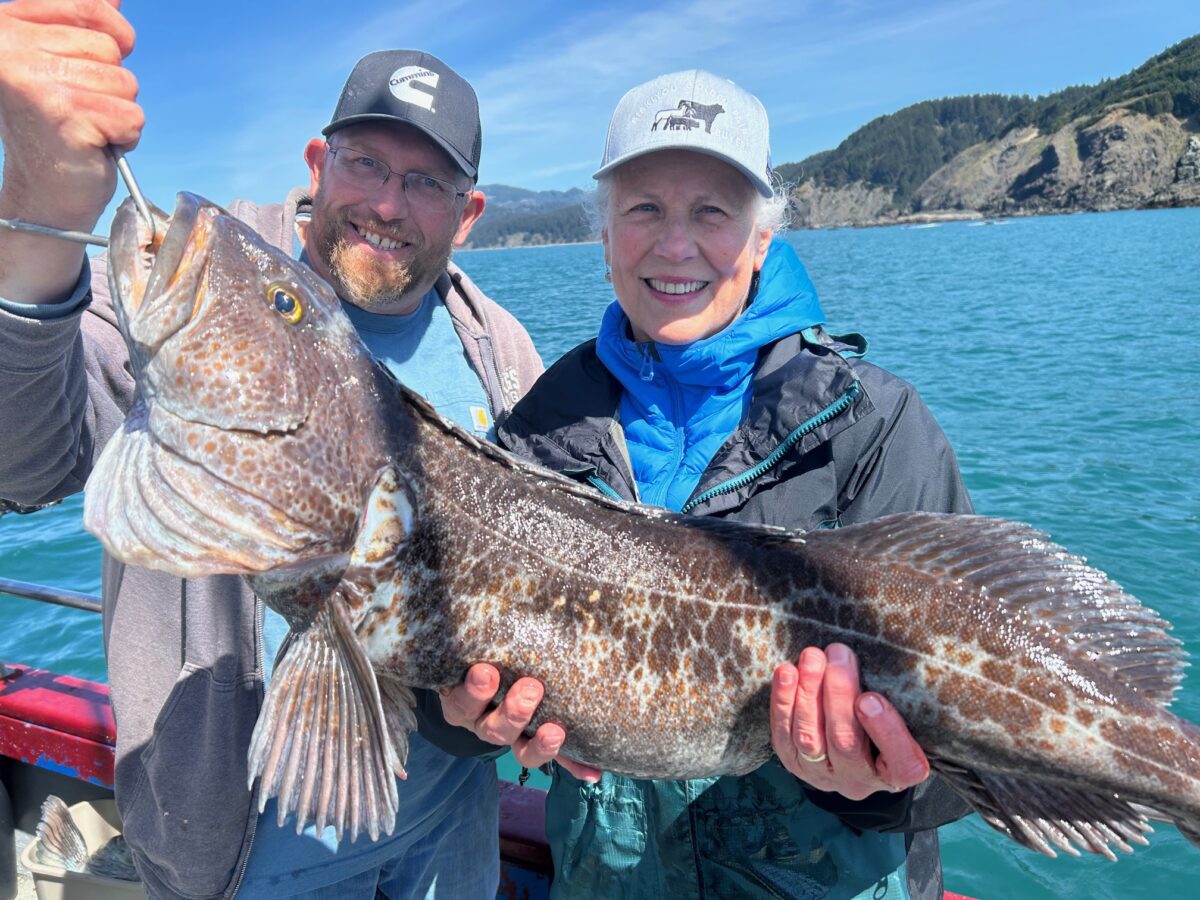
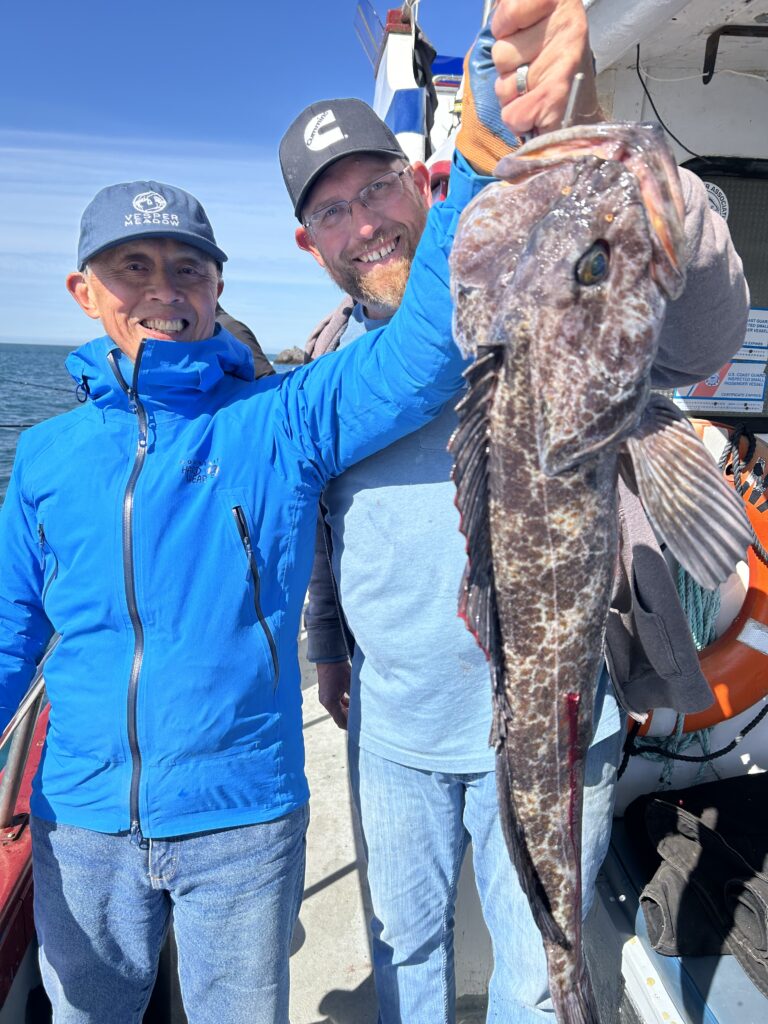
Deckhand Eric holds a nice lingcod caught in April 2025 aboard the Miss Brooke.Another nice lingcod caught aboard the Nauti-Lady in April 2025.
Lingcod fishing remains good in April and May, before some of the fish migrate back to deeper water. Until then, fast and furious action is common over the shallow reefs near Brookings. Our charter boats have been doing well from Twin Rocks and House Rock to Mack Arch, Arch Rock and Mack Reef.
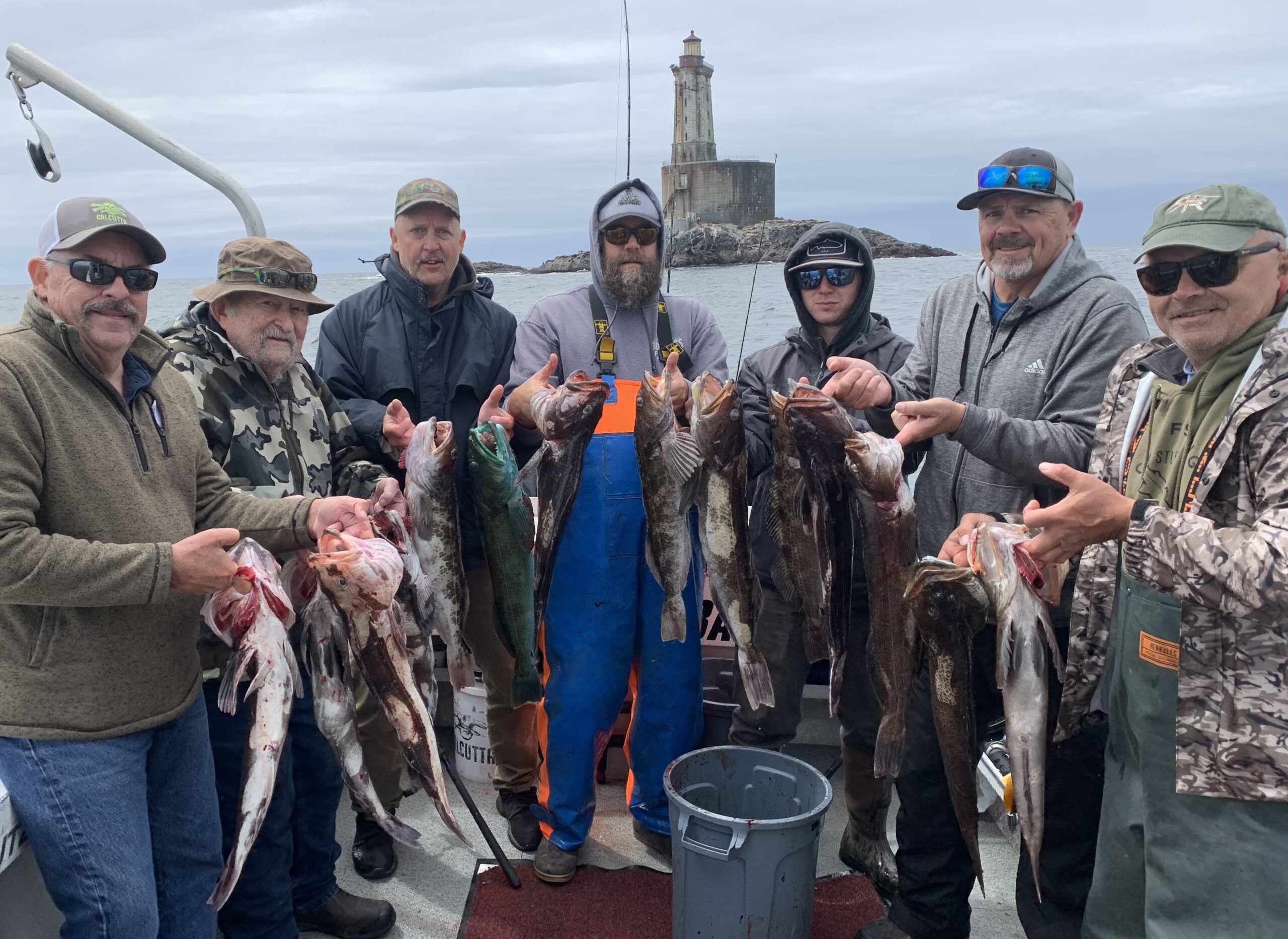
In May, fishing for trophy lingcod will get even better, as the Point St. George Reef next to the historic Point St. George Lighthouse opens to fishing. It provides some of the best lingcod and rockfish action outside of Alaska. Halibut season also opens May 1 out of Brookings.
Capt. Sam with a lingcod caught aboard the Nauti-Lady.
Spring salmon also are being caught on the Rogue River near Gold Beach, Oregon. Capt. Rye has been focusing on Rogue springers, and finding some beautiful ocean-bright fish. Springer season runs April through June, and April and early May are prime time.
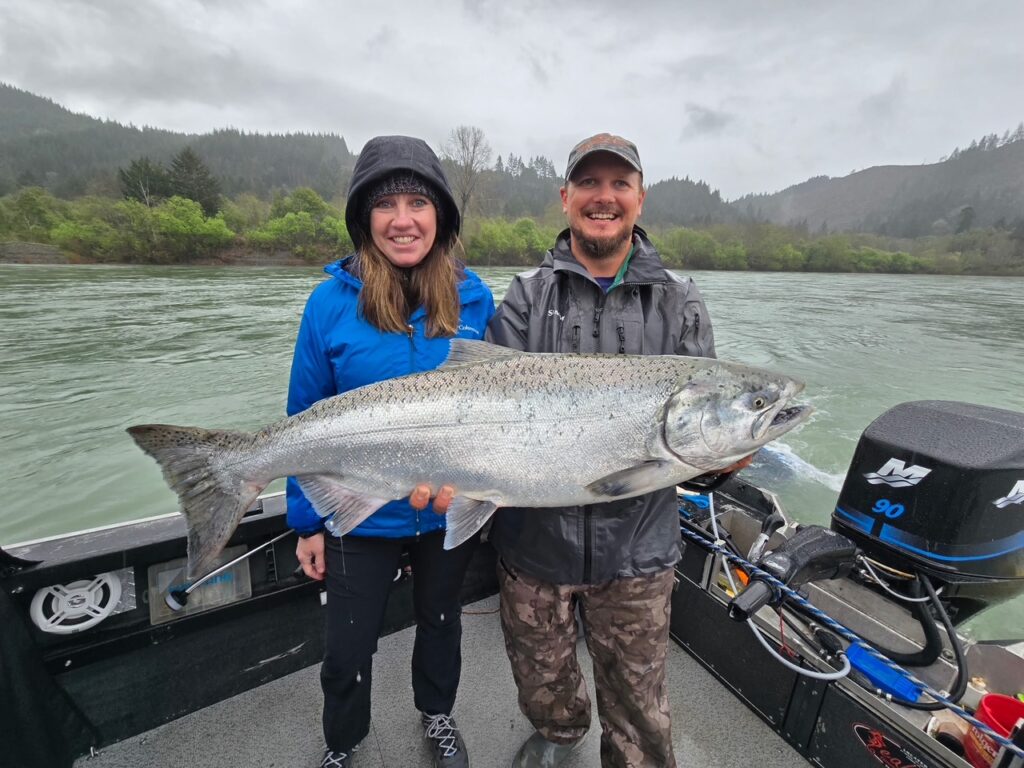
Capt. Rye holds a chrome-bright Rogue River spring king salmon caught in early April 2025.
Springers are caught from boats anchored in the slower water, using the current to spin anchovies. The bite is the hardest pull down a salmon angler will ever see. The springers hit, and then turn into the current, charging full speed downstream. It’s similar to the massive strikes made famous on Wicked Tuna. To book a Rogue River spring salmon trip, call our office at (541) 813-1082.
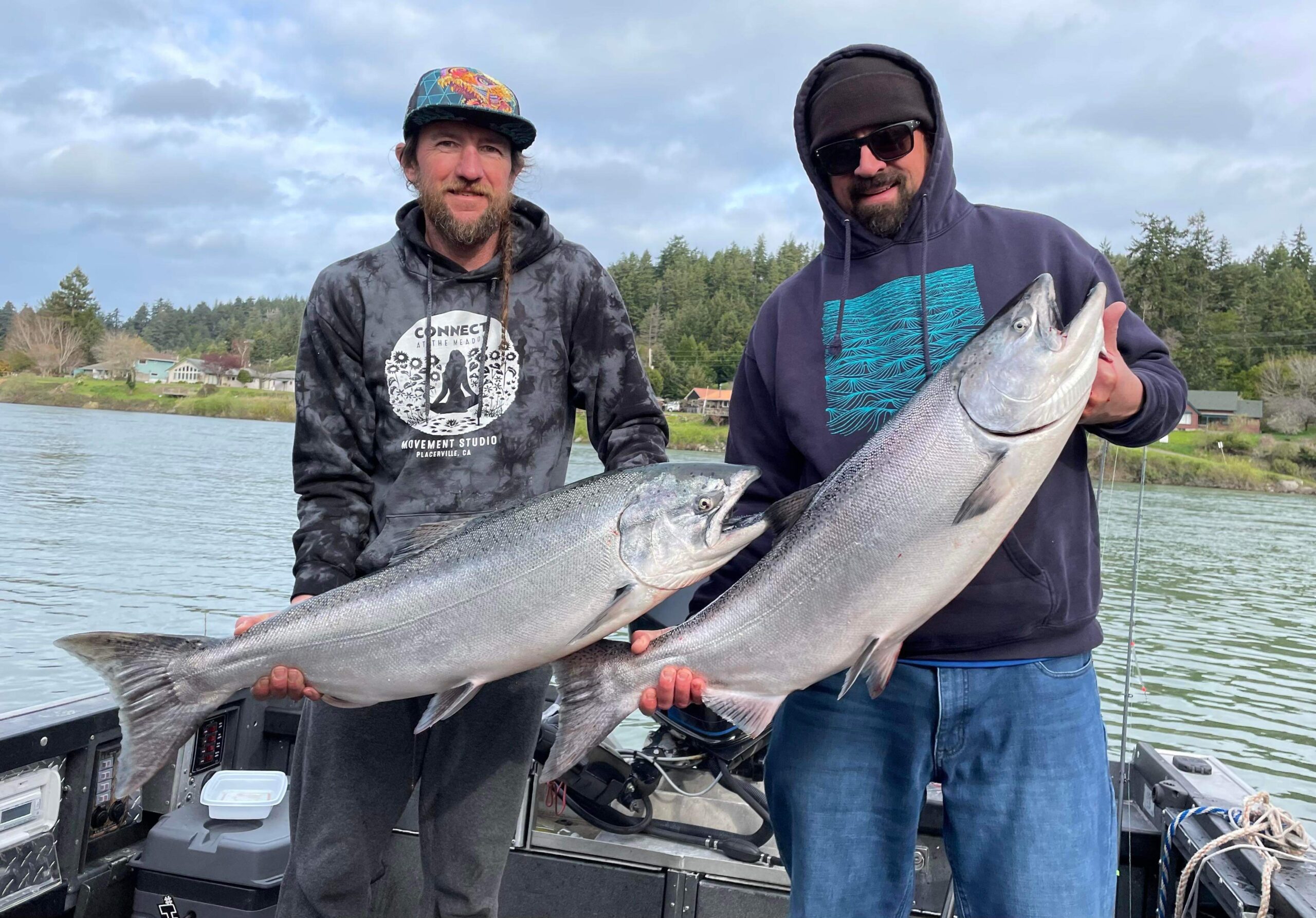
Another nice springer caught in early April with Capt. Rye on the Rogue River, fishing from the comfort of a covered jet boat.
Ocean lingcod and rockfish trips will run daily through the spring and summer as the weather allows. Trips are available on the Nauti-Lady, Miss Brooke, Kraken, Papa B and Dash. To book an ocean charter boat out of Brookings, call (541) 813-1082 or visit www.brookingsfishing.com.
Capt. Andy helps a customer hold a 19-pound lingcod caught aboard the Nauti-Lady.
Here are some of the great catches from the past week with the Brookings Fishing Charters fleet.
BROOKINGS, Ore. (March 31, 2025) – The Oregon Coast has experienced a stormy, very wet and rainy winter and early spring, limiting the number of days boats can get offshore for lingcod and rockfish. But on calmer weather days between storms, fishing has been good, with limits of rockfish and lots of nice lingcod. Now that Spring has officially arrived, better weather is in the forecast. The second half of this coming week has the best weather forecast so far this year, with light winds, small swells, sunny weather – the making of what should be great fishing off the coast of Brookings.
A pair of nice lingcod from the Nauti-Lady in mid-March.
Our charter boats have seized the weather openings between storms to run trips, returning to port with nice limits of rockfish and plenty of lingcod. On calmer weather days, the lingcod fishing has been excellent. During big swells, rockfish are still eagerly biting, but lingcod have been tougher to come by.
Another limit of lingcod from the Nauti-Lady in March 2025.
Fishing on rocky reefs in shallow water, using light tackle, the rockfish action is often wide open this time of year. We are finding a mix of large black rockfish, blue and deacon rockfish, canaries, vermillion, China and an occasional copper rockfish. Lots of smaller rockfish are mixed in, but with the lighter tackle and shallower water, they are easy to release unharmed. April and May usually signals the start of the surface bite, where rockfish are caught just under the surface as they feed on freshly spawned baitfish and crab spawn.
Deckhand Eric holds a lingcod caught aboard the Nauti-Lady.
Lingcod also are still in shallow water after the winter spawn. Most of the lingcod caught on recent trips have been in 20 to 40 feet of water. Our boats have done best at House Rock and Mack Arch for lingcod, the typical destination of our six-hour long-range charters.
Pacific halibut season opens May 1, along with our trophy lingcod and rockfish season at the Point St. George Reef Lighthouse. This season, the Nauti-Lady, Miss Brooke and Kraken will be running trips to the lighthouse. While halibut is open May 1, the best fishing is from late June through September.
We will learn our 2025 ocean salmon dates for the Oregon Coast next week, after the Pacific Fishery Management Council sets ocean seasons for Oregon, California and Washington. Early indications show a mid-May through early June king salmon season, and early June through August hatchery coho season. The best coho action off of Brookings is mid to late June, when action is often wide open.
Spring king salmon caught on the lower Rogue River with Capt. Rye. April and May are prime time for Rogue springers.
Winter steelhead season closed March 31 on the Chetco and remains open through April on the Smith River. Our river guides are switching gears to the Rogue River for spring king salmon. Capt. Rye, Mick and Sam will be running trips from their jet boats for these hard-fighting, great-eating springer salmon. Call (541) 813-1082 to book a spring king salmon trip.
Ocean charters will run daily now through the early fall, weather permitting. Book online at www.brookingsfishing.com, or call our booking office at (541) 813-1082.
Here are some more recent catches from our ocean charters in March.
BROOKINGS, Ore. (Feb. 22, 2025) – Limits of rockfish, lots of lingcod and a few Dungeness crab to end the day have made for exciting winter charter boat trips out of Brookings so far this winter, with good fishing on the nice weather days between storms. Chrome-bright steelhead, meanwhile, are entering local rivers, giving anglers plenty of options for February and March fishing trips.
Ocean lingcod and rockfish action has been above average so far this winter, with more lingcod than recent years in January and February. Steelhead fishing, on the other hand, has been slower than expected coastwide, with just a couple steelhead per boat on most days.
Customers with limits of lingcod aboard the Miss Brooke in February 2025.
The Miss Brooke, Nauti-Lady and Papa B have been running ocean charters as the weather allows between storms. The rockfish action has been hot, with lots of smaller fish released and a good grade for limits. Lingcod also are biting aggressively, with limits typical on the longer 6-plus-hour trips, and a fish or rod or better on the shorter 4-hour trips. On long-range trips to Mack Arch, the lingcod bite has been wide open, with limits and plenty of smaller lingcod released, as well as some larger breeders let go as well.
A large steelhead caught with Capt. Andy on the Chetco River in February 2025.
Steelhead fishing will remain a solid option well into March. Our ocean charter boat captains are also river guides, and fish out of drift boats during the fall and winter when the ocean is too rough to fish. They use light spinning tackle to drift tiny clusters of roe for steelhead. The scenic floats down the Chetco and Smith rivers are memorable, and the hard-fighting steelhead are among the most prized an angler can catch.
A limit of lingcod from the Miss Brooke in January 2025.
During the winter months, lingcod move into shallow water to spawn. Big numbers of fish congregate over rockpiles in 20 to 50 feet of water. Many of the lingcod are caught on typical rockfish gear, but once limits of rockfish are caught, our captains switch over to larger jigs and bigger baits to specifically target lingcod. The catch rate of the Brookings Fishing Charters crew speaks for itself – our captains have a well-earned reputation for catching quality rockfish and lots of lingcod using light tackle in shallow water.
Capt. Andy with a pair of nice lingcod caught aboard the Nauti-Lady in February 2025.Deckhand Eric with a pair of lingcod caught aboard the Miss Brooke in January 2025.
Ocean fishing is open year round out of the Port of Brookings, which also has the safest bar crossing on the Oregon Coast. Our crew is ready to fish each time there is a break in the weather and it is safe to get out and fish for lingcod and rockfish. Trips are available aboard the Nauti-Lady, our 42-foot boat, as well as the 30-foot six-pack charter boats Miss Brooke, Kraken, Papa B and Dash.
The Nauti-Lady hovers of a big school of rockfish near House Rock in January 2025.
Ocean salmon dates will be announced in April 2025. Pacific halibut season opens May 1. The highly anticipated season at Point St. George Reef Lighthouse also opens May 1. Albacore tuna trips are offered in July, August and September, once the fish get within 30 miles of the coastline.
Here are some of the recent lingcod and rockfish catches aboard our charter boats out of Brookings.
Steelhead season closes March 31 on the Chetco, and April 30 on the Smith. Spring king salmon action runs mid-March through June. To book an ocean charter or spring king salmon trip, call (541) 813-1082. Learn more about ocean charters at www.brookingsfishing.com. Learn about river trips at www.wildriversfishing.com.
Here are some recent steelhead catches with our river guides.
By Rich Holland (Pacific Coast Sportfishing) – Albacore! Once the driving force of Southern California sportfishing, albacore have been gone a long time from local and Baja banks. Gone so long that when bursting to tell the tale of an epic summer bite in Oregon after I got home last summer, it became apparent that any local angler in their 20’s didn’t even know what an albacore was.
Capt. Rye Phillips holds fists full of albacore tuna caught aboard his charter boat, the Dash, part of the Brookings Fishing Charters fleet.
Yes, an entire SoCal generation has gone without chasing albacore, longfin, albies, chicken of the sea, or whatever you wanted to call the tasty white meat tuna with impossibly long pectoral fins that the gun-blue and silver bodied fish use to literally glide thousands of miles around the Pacific. Yet it was also clear from social media that older and not-so-old SoCal anglers remembered the days when albacore fishing was king. They, too, had journeyed last summer to Northwest waters from California’s Fort Bragg and Shelter Cove, Oregon’s Brookings and Newport, and Washington’s Ilwaco and Westport and scored big on the longfin tuna.
There’s nothing prettier than the blue of albacore water. Somewhere off the coast of Brookings, Oregon.
Here’s Where You Can CATCH ALBACORE This Summer
They are going back. And so am I.
Here’s where, when and how we caught them.
Brookings, Oregon Capt. Sam Stover pulled the charter boat Kraken up to the dock in Brookings-Harbor after taking our group on a successful lingcod and rockfish run to the Point St. George Reef Lighthouse, 12 miles south in California waters. Capt. Andy Martin, owner of the Kraken and Brookings Fishing Charters, soon found us with some highly anticipated good news. “We’re a go for the albacore tomorrow!” said Martin, adding, “The boats are all leaving at 4 a.m.” Scramble time. Albacore gear poured down in carts as we took our gear and fish up to the truck. Go, go, go! Sleep a little.
Capt. Mick Thomas with a hefty albacore tuna caught off the coast of Brookings.
Beat up, bedraggled, tired and excited, as ready as we would ever be, we were back on the Kraken way before the crack of dawn and passed the mothership Nauti-Lady, a 41-footer licensed for 26 anglers, deck lights on and the dock lines coming in. Then we trailed the lights of the other 29-foot twin outboard, heavy-hulled aluminums Miss Brooke, Papa B and Dash into the main channel of the Chetco River and across the bar. Earlier, Andy had explained where he hoped to find the mother lode. “The spot of good water 20 miles out looks isolated on the latest charts, so we’ll be heading up north about 35 miles to an area off Gold Beach where we have a pin on where some fish were caught. Then we’ll spread out and look for the albacore.”
The Nauti-Lady enroute to the tuna grounds of off Brookings at first light.
By the time the Kraken got to the area, the seas and winds had both picked up. It was gusting up to 15 knots and the boats had scattered and radio communication was sketchy. As the sun turned the wind chop golden, we could see albatross and shearwaters skimming the wake and waves. The more we could see as the sun came up, the water looked pretty good, too. Albacore water is magical. Picture the purest blue that turns to a dense purple as it deepens. Find the water and the birds and the albacore will be there. Deckhand Chris Cooke put out a couple hand lines and some feathers (plastic, tinsel, feather, vinyl etc. trolling lures) on four troll setups, too. Patrick Bird and Patrick, Jr. eagle-eyed the rods in the holders and Brookings local Mark Gasich, an old friend invited by Andy to join us, tended to his Mexican flag (green, yellow, red) lure. Soon Mark had a fish on that hit and pulled like an albacore. And fell off halfway to the boat. As we drifted, we slid over into dirty water. As Mark said, it might not have even been an albacore. I didn’t believe it. We just had to get into the really good water. We went looking.
A nice score of albacore tuna caught aboard the Dash of the Brookings Fishing Charters fleet.Customers aboard the Nauti-Lady with some of the albacore caught using P-Line Tuna Ripper jigs.
Soon, a boat loomed on the horizon exactly in the direction the Nauti-Lady should be coming from. The tall antennas on the boat’s house sent and received us loud and clear and worked as a relay to the rest of the fleet. Capt. Travis Sallander on Miss Brooke was on the fish, and both Capt. Mick Thomas on the Dash and Capt. Mike Brouillette on the Papa B were either in ‘em or on the way. Once Andy managed to get one of the busy captains to give him the complete lat/long numbers, we were on the way too. The water went from chlorophyll powder blue with a ton of birds and no fish to perfect and birds over fish. Sam slowed down and in went the jigs. The starboard handline bounced tight and two trolling rigs doubled over. The deck was bloodied with all three albacore (so good to see after so long). Happy does not describe the feeling. More like building greed and exultation.
Nauti-Lady Capt. Andy Martin holds a pair of albacore tuna caught by longtime Brookings Fishing Charters Barb Hunt of Medford, Oregon.
We could see boats in the distance, and the chatter sounded so good we kept the lures out of the water and ran to the meat of the matter. The albacore, as so often, definitely were concentrated in one area and they were hungry. And they are extremely fun to catch on modern tackle. The same rig you would use to finesse fish for bluefin – and what Andy uses for Pacific halibut on trips both local and in Alaska – is perfect for trolling. That is, a strong, single speed 20- to 30-size casting reel packed with braid and a small diameter composite rod with a moderately fast tip and lifting power.
A typical Oregon Coast albacore tuna.
Of course, Mark’s old school gold reel and troll rod monofilament setup worked too. The Birds perched over their chosen setups, and they didn’t have to wait long. Several times, all six lines in the water loaded up with albies – first two or three fish would stick, then a couple more as Sam throttled back a bit, then the last one or two. Never less than three. A handful were “peanuts,” a term for albies under 10 pounds, but most were the good grade that fill the freezer. We took turns bouncing the handline fish over the rail and if there was a reel with the clicker still singing, you’d grab that. Better still, if fish were still hanging – and 15- to 20-pound albacore hit hard and pull hard enough for some good strong runs – it was time to reach for a drop-back bait.
Capt. Andy Martin with a nice albacore tuna caught aboard the Nauti-Lady.A tote full of iced tuna back at the harbor in Brookings.
To this writer, nothing is more fun than a swimbait, and Mark and I had some classic Channel Island ‘Chovie Fish Traps with us. It’s always a good sign when you can see free swimmers and followers flashing behind the boat. The first cast got bumped. I wound it faster and watched a beautiful bright-eyed albacore line up and blast the lure at the surface 20 feet off the stern. A tight drag on the Trinidad 20 with 50-pound braid and a 40-pound Seaguar leader resulted in a marlin-like head shake and it looked like the fish would come right up at the side of the Kraken – the crystal blue water illuminates the fish. In a wink, the longfin put its head down and dove deep into the cobalt darkness. Back came the fish wings spread and circling. One more sidewise dash and the 20-plus pounder was done. Then Pat Jr. Landed a trolled fish just about as big and Mark’s similarly-sized albie spit a swimbait right at the gaff. Slice, bleed, ice, repeat. It was the same for the entire squadron of five vessels. Run and gun and get it done. “We have enough ice and space left to do another pass,” said Sam. “Unless you guys have had enough and want to head back.” “I want to make another pass,” said the senior Patrick in his Irish brogue. We did, and we caught. On the way back, Patrick explained his thinking.
Oregon Coast albacore tuna caught with the Brookings Fishing Charters crew.
“You know, you get into a special day of fishing and you know you have caught enough. Still, you just don’t want it to end.” Brookings is a large town located a short drive north of the California border on Hwy 101. Summer tourists pour through for the old growth redwood groves and stunning coastline. Anglers head to Brookings Harbor at the mouth of the Chetco River. There is a small airport in Crescent City below the border and a major airport in Medford a bit more than two hours from the coast on Hwy 199. Ever since our small group of family and friends started doing summer trips to Brookings with Andy Martin’s operation instead of Alaska, albacore have always been a possibility.
Nauti-Lady deckhand Eric Howard helps a customer display an albacore destined to make more than a few tasty meal.
Not a given. We pick a week when regulations say just about any briny fish is fair game. Albies were caught the week before and the week after, or two weeks later. Or the wind blew hard outside the protected inner waters. Targeting albacore calls for more flexibility, said Martin. The season in the Brookings area is roughly late July to mid-September, with August the most reliable. “On the southern Oregon coast, you can’t really pick a week a long time in advance and expect to catch albacore,” noted Martin. “We do it off a call list. We watch the water temps and charts and wait for the weather to align. We’re lucky because the Chetco River Bar is one of the easiest to get across in Oregon. Our goal is a dozen trips a year and that’s it. Lots of times we send all five boats out, as the guys who have booked other trips usually opt in. If the albacore fishing is really good, we’ll cancel the other trips and go straight albacore. “To me, it seems the abundance of albacore off the southern Oregon coast is just getting better and better; the abundance of bait fish is better, so I think it is just going to get better,” Martin added. “Our catch rate is certainly getting better. The charts, the sonar, communication technology are so much better – we know the next day where fish have been caught – and because people, especially the private boats, have figured out how to catch them. “More so, I think there is simply more albacore.”
To book a trip with Brookings Fishing Charters, call (541) 813-1082.
Capt. Mick and Capt. Mike with albacore caught off the coast of Brookings.Kraken deckhand Chris Cooke deals with albacore caught during a hot bite.A nice albacore caught aboard the Miss Brooke.
Fort Bragg, California
Capt. Brandon Hayward is best known these days for his and his fellow Bight Sportfishing captains’ white seabass and bluefin tuna catches. What you might not know is Hayward was working the deck of Ray Sobiek’s Producer when the albacore returned to San Diego in 1997 and rode out the last San Diego surge of albacore working on the Excel until August of 2005. Always looking to be on the front edge of the fishing curve, Brandon and crew jumped into Northwest albacore action last summer, trailering boats up for charters out of Fort Bragg. Hayward’s new cat-hull might be the vessel this summer. “I talked with Pete Grosbeck before I went up and what he told me is that it’s the same as albacore fishing anywhere – it’s all about the water structure,” said Hayward. “What I learned was that going up in September was on the late side, the season gets going in August. “We caught the albacore just like we catch them here, mostly on Rapalas and feathers,” he noted. “We were late – I heard it’s different farther north – so we worked hard running and looking for loose jumpers and that kind of thing.” Hayward’s customers are encouraged to fly into Santa Rosa (there are flights from both Burbank and San Diego), rent a car and take the short scenic drive through wine country up to the edge of the Lost Coast. “Fort Bragg is a great harbor , it reminds me of New England with little seafood restaurants, nice places to stay and processors right there. I really enjoy it,” said Brandon. “If you want to bring your own boat, slips are dirt cheap, and there is an easily accessible launch ramp. There’s no live bait, so bring some salted an – chovies or whatever.” Bigger tuna also move into rich Northwest waters. “We missed the bigeye tuna that Pete Grosbeck and his buddies got,” Hayward. “They caught them on the MadMacs just like we catch bluefin down here. They were staying out all night fishing late afternoon and early morning. “While we were in Fort Bragg, down the line blue – fin tuna were jumping and boiling on smelt outside the kelp line in 90 feet of water . One fisherman I talked to was catching 100 pounders just a few miles below the harbor,” Brandon added. “We kept running outside for albacore. “I wonder which way a boat would have headed if that was the case 20 years ago when the albacore were still around San Diego?”
Ilwaco, Washington
As noted, this is not the first point in time albacore have abandoned the waters of Southern California and Baja California. The way to satisfy albacore lust was to head way up north to Westport, Washington, where a lot of albacore boats have been built in the Westport Shipyard (now Westport Yachts). Andy Martin’s Nauti-Lady is a Westport that he bought in Ilwaco. Ilwaco, Washington, is a harbor town tucked up behind Cape Disappointment at the mouth of the Columbia River. Ilwaco is where Lawrence “Squig” Quigley of Fishworks headed last summer in late August to fish for albacore with Capt. Shawn Trowbridge, Ryan Herzog and his son Shawn, Jr. Trowbridge is a name familiar to many who have fished out of San Diego. He purchased the Tracer in 2022 after it had been moved to Ilwaco to be fished commercially (unsuccessfully) and completely refitted the 55-foot vessel into a luxury six-pack. Shawn renamed the converted boat Legendz. “Originally it was a Westport called the Aurora and brought down to San Diego and named the Tracer,” said Trowbridge. “After it moved back north it had been trashed and left at the dock for three years. It made more sense to buy it for the hull rather than buy a new boat. The Legendz is more like a yacht now.” A yacht with modern sonar and two 30-scoop bait wells. “Not many boats up here have more than a 5-scoop bait tank and except for one commercial boat, I believe we’re the only boat in the harbor with sonar,” said Trowbridge. “It’s pretty easy to find fish up here, mainly bird schools. We’ll troll some, but once it’s August and the albacore are on the birds, it’s one-stop shopping. “We’ve never had a trip with less than eight to 10 fish per rod,” he added. Shawn also noted that all of his business comes from “down there.” “We caught 68 albacore in a day-and-a-half fishing 30 miles out, it was crazy” said Fishworks’ Squig after his trip from down there to up there. “The anchovies were huge; I have never seen them that big. There’s a live bait receiver in the harbor and a fish processor right near the docks.” “What we have our customers do is hop on a plane that gets in early to Portland, about 9 or so, and we shuttle them to the boat, leave the dock at noon and we get in a solid five hours of fishing 25 to 40 miles out,” explained Trowbridge. “Then it’s dinner, the customers sleep, get up early and do the gray bite thing, and we’re usually on way the home by 9 or 10 with all the fish we need. We have a nice hotel nearby that most people stay at while their fish are processed. In the morning, they pick up their fish, we take them to the airport and pick up the next group. “We do that from August through September. The lightest line we fish with is 30-pound, and I use a Talica with 80 and horse ‘em! We have all the gear – Accurates, Talicas, Fathoms – so just bring clothes. Some stay for a while on Long Beach Peninsula, it’s a vacation spot. “My biggest problem is we run out of groups after Labor Day and in Sep – tember the fish are all bigger. My son and I had 39 one day by ourselves, and you can’t bounce those fish, so you have to take the time to gaf f them. I’m getting too old to catch all those fish in one day. The plan is to pass the operation on to my son.”
BROOKINGS, Ore. (Jan. 16, 2025) – While the ocean has been choppy and windy, with plenty of big swells, there have been a few windows of nice weather in January, allowing our charter boats to get offshore to target lingcod and rockfish, and check crab pots on the way in. Limits of quality rockfish are being caught, with nice lingcod mixed in, and an exclamation point to the day with fresh crab.
The Nauti-Lady and Miss Brooke have been running ocean charters this month, between storm events, while the rest of the Brookings Fishing Charters crew is focusing on winter steelhead drift boat trips on the Chetco and Smith rivers. As the rivers begin to drop to low, clear conditions as the storm door temporarily closes, the ridge of high pressure in the weather patterns often makes for fishable ocean conditions. We are planning more ocean charters the second half of January.
A pair of nice lingcod from a trip this month on the Nauti-Lady.Jumbo crab on the Nauti-Lady. We have been setting pots on the way out, and checking them before returning to the docks.
When the weather allows during the winter months, lingcod fishing is often good, as fish move into shallower water to stage to spawn. Large numbers of lingcod, which spend most of their life in deeper water offshore, come to the shallow reefs December through April. We use light tackle to fish for lingcod when they are in shallow water, often catching them at depths less than 40 feet.
Lingcod from a recent trip aboard the Nauti-Lady.A lingcod that fell for a light jig aboard the Miss Brooke in 30 feet of water.
Big schools of rockfish are in shallow water, producing quick limits. We use light spinning rods to catch the rockfish. Caught in shallow water, smaller fish can safely be released without harm, and anglers can sort through quality limits.’
Nice grade of rockfish during a hot bite aboard the Miss Brooke.
Steelhead fishing has been fair on the local rivers. After weeks of high water, the rivers are dropping to low, clear conditions. Expect big numbers of hatchery fish after the next rain. Here are a few steelhead catches with our guides this past week.
To book an ocean charter, call (541) 813-1082. More information about our trips is available at www.brookingsfishing.com.
Here are some more catches from the past week on our charter boats.
Also check out our web site for dozens of delicious seafood recipes. Click here for our latest recipes.
BROOKINGS, Ore. (Jan. 2, 2025) – A brief weather window on New Year’s Eve, with a lull in the winter storms, allowed the Nauti-Lady to venture offshore for rockfish and lingcod, with steady action, a wide assortment of fish, and family fun to end 2024.
Happy New Year from the Brookings Fishing Charters crew.
Stormy weather kept the charter fleet at the docks most of December, but lighter winds and smaller swells provided an opportunity to get out on Dec. 31. Families from Eastern Washington, Sacramento and Canby, Ore., caught limits of rockfish, with some lingcod and cabezon mixed in. By the time the Nauti-Lady was back at the docks, windy, rainy, stormy weather had returned. Another break in the weather is expected this coming week, which should allow the Brookings Fishing Charters crew to get back on the ocean, while also starting the peak season of winter steelhead drift boat fishing on the Chetco and Smith rivers. The Brookings Fishing Charters team of saltwater charter boat captains are also river guides during the fall and winter months, when the ocean is too rough to fish.
Rockfish season is open year round in Oregon, and a nice variety of fish are available during the winter months. A couple of young anglers are all smiles after landing rockfish and cabezon.Lingcod move into shallow water to spawn during the winter, making them easier to catch on light tackle.Customers enjoy a beak in the weather New Year’s Day aboard the Nauti-Lady offshore of Brookings, Oregon.
Some of the best lingcod fishing of the year takes place during the winter months, as fish move into shallow water to spawn. Catch rates are often the highest of the year from January through April, during the peak of the spawning period. Rockfish season is open year round, and limits are common during the winter months.
The Brookings Fishing Charters crew uses light tackle to target rockfish and lingcod. Quality spinning combos make for exciting action once fish are hooked up. On a typical trip, anglers will start out with rockfish gear, and as limits are caught, switch over to bigger jigs to target lingcod.
A young angler takes the bat to her first-ever lingcod.Fish on! a lingcod is brought to the surface with a light spinning rod.Another lingcod caught New Year’s Eve aboard the Nauti-Lady.Capt. Sam helps a young angler hold his first-ever lingcod.
Lingcod and rockfish season is open year round. Ocean salmon season generally runs late May through August. Final season dates are approved by federal fishery managers in April. The Point St. George Reef Lighthouse, home of our trophy lingcod and rockfish fishery, is set to open in May. Halibut season runs May 1-Oct. 31.
To book a trip, call (541) 813-1082.
If you haven’t checked out our recipe page, we post new recipes throughout the season. Our latest is Coconut-Crusted Lingcod with Sweet Chili Sauce. Check it out here.
Coconut-Crusted Lingcod and Shrimp with Sweet Chili Sauce.
BROOKINGS, Ore. (Nov. 22, 2024) – With rough ocean conditions the past month, the Brookings Fishing Charters crew has been focusing on the local rivers, where fall-run king salmon are migrating into freshwater to spawn. The Chetco and Smith rivers boast some of the best drift boat salmon opportunities on the West Coast, and this year has lived up to their reputation. The Brookings Fishing Charters crew of captains and deckhands are also full-time drift boat guides in the fall and winter, and among the most experienced river guides in the region.
Capt. Andy with a hefty hatchery king salmon caught last week on the Elk River in Southern Oregon.
Salmon season in the rivers and estuaries began in September, when big kings began staging along the Chetco River jetties in Brookings. Fishing was good through October, with salmon as big as 52 pounds caught by boaters trolling flashers and anchovies. The Brookings Fishing Charters crew switched back and forth between the estuary salmon fishing and ocean charters until late October, when heavy rains increased flows on the Chetco and Smith rivers and kicked off the drift boat season upriver.
Capt. Mick with a bright Chetco River king caught on a MagLip plug.
Upriver, anglers fishing from drift boats used plugs – primarily Yakima Bait Co. MagLip and FlatFish plugs – or roe and sand shrimp, to catch big king salmon moving into the rivers to spawn. Fishing was good through November, until a series of big storms, with hurricane-force winds and heavy rain, brought the rivers to minor flood stage.
Capt. Sam with a big Smith River king, which was released after a quick photograph.Capt. Rye with a large hatchery king salmon from the Chetco River estuary.
This fall we welcomed two new drift boat guides to our crew, although they have been members of our team for several years. Eric and Chris, who have been deckhands on our ocean charter boats, successfully ran their first drift boat trips with customers this fall. Chris completed his Coast Guard captain’s class this spring, is now licensed to run our ocean boats and river boats. He has been having a good fall Chinook season on the Chetco. Eric, who started work with us when he was 16 and a sophomore in high school, graduated in June and is now running drift boat trips and deckhanding on the Nauti-Lady while he completes his Coast Guard license classes.
Capt. Chris holds a nice Chetco River king salmon.Eric holds a nice Chetco estuary king caught while deckhanding for Capt. Rye.
We will continue to fun drift boat trips for salmon into December. The Elk and Sixes rivers have a later run of fall kings, while fresh fish also will trickle into the Chetco and Smith rivers. Winter steelhead season begins Dec. 1 and runs through March. Late December, January and February are the peak season for winter steelhead. Our guides will run salmon and steelhead combo trips through mid-December, then switch gears just to side-drifting for steelhead.
To learn more about our drift boat trips, visit www.wildriversfishing.com.
Ocean charters will resume next week with good weather on the forecast. When the weather cooperates, our crew splits time between the ocean and rivers.
Here are some of the recent drift boat salmon catches with our crew.
BROOKINGS, Ore. (Aug. 3, 2024) – Some of the best fishing action of the year is happening now on the Oregon Coast, with a wide variety of opportunities. The first tuna of the season caught by any of the local charters hit the docks this week, while king and coho salmon are still biting, halibut fishing is improving, and the lingcod action has been wide-open on our long-range trips to Point St. George Reef and Mack Arch. August is one of the best times of the year to fish out of Brookings, with lots of options for visiting anglers.
The first albacore tuna of the season caught on a charter boat out of Brookings in 2024, landed aboard the Dash with Capt. Mick. The day ended with five dozen albacore landed.
The Dash, with Capt. Mick, ran the first albacore tuna charter of the season out of Brookings on Aug. 2, and returned with its totes and fish bags stuffed full of tasty albacore. The first charter yielded five dozen albacore, caught on both rod and reel and hand lines. The fish were 35 miles straight out from the harbor, with 60-degree water as close as 30 miles. Tuna trips are booked off of a call list. Call (541) 813-1082 to include your name, and our booking office will call as trips are put together, based on calm weather forecasts and current fishing reports.
Limits of hatchery coho salmon caught in July aboard the Miss Brooke.
Salmon season remains a solid bet out of Brookings, although the action has been hit-and-miss. Many of the hatchery coho have already migrated north, but we are still seeing keeper fish each day, and there have been good days for larger kings mixed in. This past week, our trips produced big numbers of wild coho and kings that were less than 24 inches, both of which must be released. Lots of action, but not as many keepers as were saw earlier in the season. Salmon season still has three weeks remaining, and fish will be available through the month.
The results of a double-hookup of halibut aboard the Papa B this week.A big halibut caught on the Papa B in July.
Pacific halibut fishing has been decent, with a few very good days mixed in. August and early September are peak season, so expect good catches all month. We are fishing for halibut in 180 to 250 feet of water. The fish have been 15 to 50 pounds. For the past several years, catch rates have increased substantially in August.
Check out this trophy lingcod caught this week aboard the Kraken!
Our long-range charters to the Point St. George Reef Lighthouse and Mack Arch have resulted in some of the best lingcod action we’ve seen in recent memory during the summer months. Limits are common, with fish up to 30 pounds. The grade of rockfish has been phenomenal. Plenty of smaller lingcod released as well, a good sign for next year’s seasons.
Capt. Sam and Capt. Chris with some of the lingcod caught this week on the Kraken.
During our local half-day charters, fishing has been good for rockfish, with limits daily, and better-than-average lingcod fishing. Most trips are resulting in a lingcod per rod on our 4- and 6-hour charters.
A pair of albacore tuna from the first Brookings Fishing Charters tuna trip of the season.
We begin river salmon trips in September at the mouth of the Chetco, and will be fishing upriver in drift boats on the Chetco and Smith rivers beginning in October. To learn more about river trips, visit www.wildriversfishing.com.
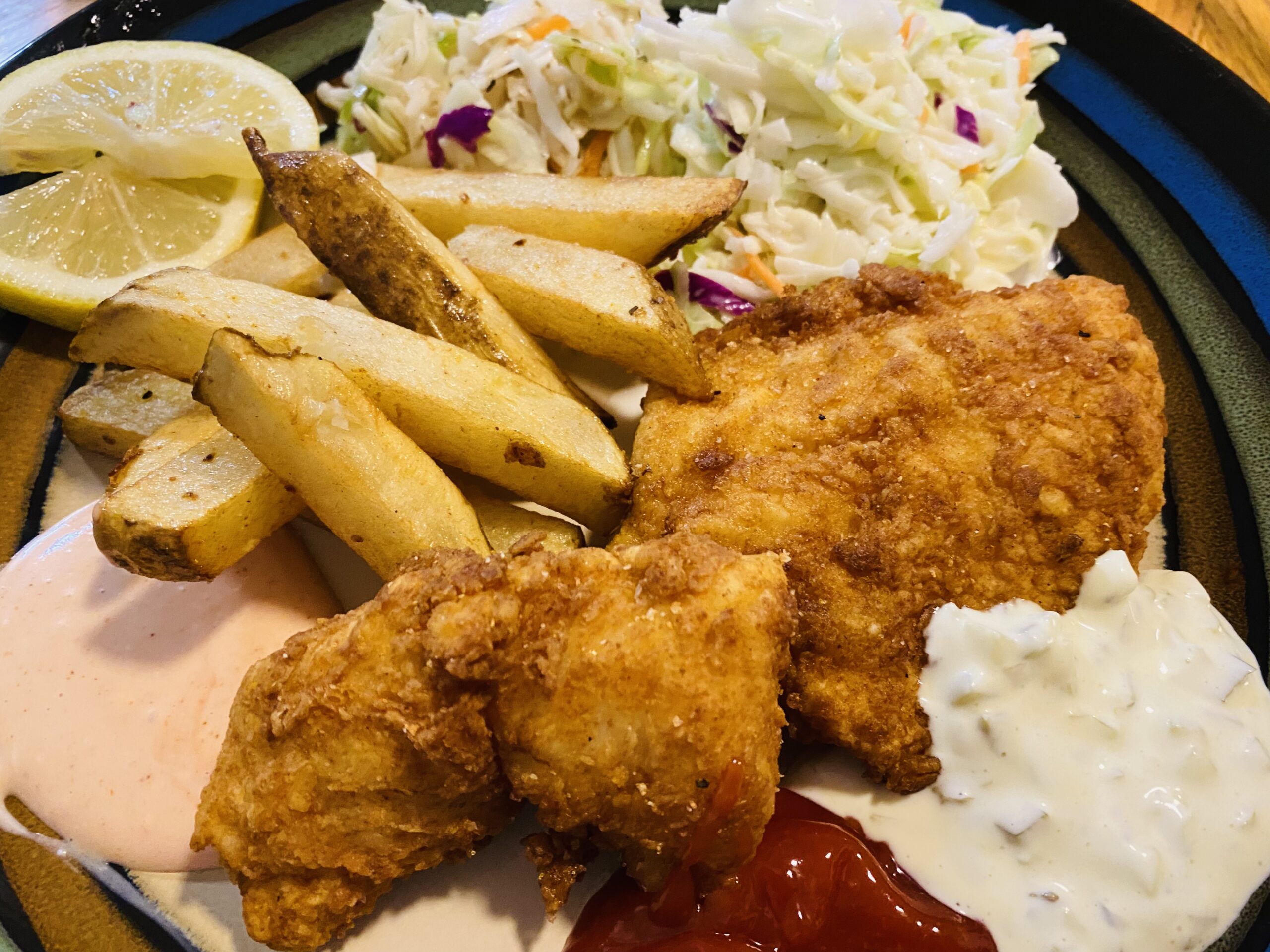
Check out our recipe for crispy, delicious beer-battered fish and chips.
The latest recipe for beer-battered rockfish, lingcod and halibut has been a huge hit. Check it out here.
By Capt. Andy Martin – Beer-battered fish and chips has long been a favorite way to enjoy the catch of the day on our charter boats. Fish coated in a mixture of beer and flour and fried to a crispy golden brown goes back to the 17th century, where immigrants to England would use the batter to prepare cod, haddock and pollock.
Perfect beer-battered fish has a crispy coating, with moist, evenly cooked fish inside.
The unique flavor, appetizing texture and sweet aroma of beer-battered fish make it one of the most popular coatings for preparing seafood throughout the United State, Canada and Europe. For years, I’ve enjoyed a simple beer batter recipe that generally makes good fish and chips, but, like most beer batter recipes, can produce soggy fish after its initial cool down.
Last year, while on a trip to Astoria to get equipment for one of my charter boats, I stopped at a very well know fish and chips stand for lunch. The deep fried albacore was worth the stop. I was immediately intrigued by the quality, texture and taste of the batter. Perfectly crispy, you could snap the fillet in half to reveal the white fish fillet with a durable yet light coating of batter. Maybe the best fish and chips I had ever had, up to that point.
Perfectly cooked beer-battered fish chunks. Use a wire rack to drain to prevent soggy fish.
I’ve had plenty of not-so-great fish and chips lunches at other restaurants throughout the coast. The fish looks good, but it’s a soggy, greasy mess. You grab a fillet and the fish plops out, leaving a clump of batter in your hand that looks like a wet tube sock. Gross.
Vodka, rice flour and turmeric are “secret” ingredients to perfect beer-battered fish.
How did the Astoria restaurant’s batter come out so good, clean and crisp? For the past year, I experimented with different beer-batter recipes, trying to figure out how to create a crispy, thin coating with perfectly cooked, moist fish inside. I heard about adding vodka to the beer batter, and that is a key to this recipe. The alcohol has a lower boiling point, so it evaporates quicker, drying out the batter to make a crispier crust.
A limit of lingcod from the Miss Brooke. Perfect for beer-battered fish!
I also found many restaurants with top-reviewed fish and chips use rice flour as part of their batter. Rice flour gives the fish a crispier crunch, and also results in a less greasy coating around the fish. A touch of turmeric powder, which is similar to ginger, gives the batter a hint of golden brown before it is even cooked, and is a secret of many restaurants that serve deep fried fish.
One of the most important steps for quality fish and chips is using cold beer, cold fish and cold batter, and hot oil (400 degrees). When the cold fish and batter is dropped in the hot oil, it helps instantly seal the fish for a crispier, less greasy serving. If the oil isn’t hot enough, you often end with a greasy mess. The vodka added to the beer also helps create the crisp, dry coating on the fish.
Capt. Andy with a halibut from the Miss Brooke of Brookings Fishing Charters.
A final vital step with fish and chips is drying the fillets on a screen or rack instead of a plate with paper towels. Setting the fish on a wire rack before serving allows them to drip and slightly cool without becoming soggy.
I like to cut the fish into smaller pieces so they cook quickly and evenly, pat dry with a paper towel, and season with sea salt and pepper. I’ll put three or four portions in the bowl of batter, gently stir around with a fork so they are completely submerged and covered with batter, and then carefully lift each fillet from the batter, one piece of a time, allowing the excess batter to drip off. The fillets can be gently rubbed along the inside of the bowl to remove excess batter. A thin coating is all that is needed.
A limit of lingcod from the Kraken with Capt. Sam Stover, perfect for beer-battered fish and chips.
Fry the fish for 3 to 5 minutes, depending on their thickness. Rockfish cook fast, halibut pieces take an extra minute or two to fully cook. Once the fish is removed from the hot oil, the middle of the fillet will continue to cook for a minute or two. I like to use an electric deep frier for the perfect 400-degree temperature. Otherwise, a cast iron skillet or Dutch oven can be used on the stove, but use a thermometer to reach that perfect 400 degrees. Peanut oil is my favorite oil for fish and chips.
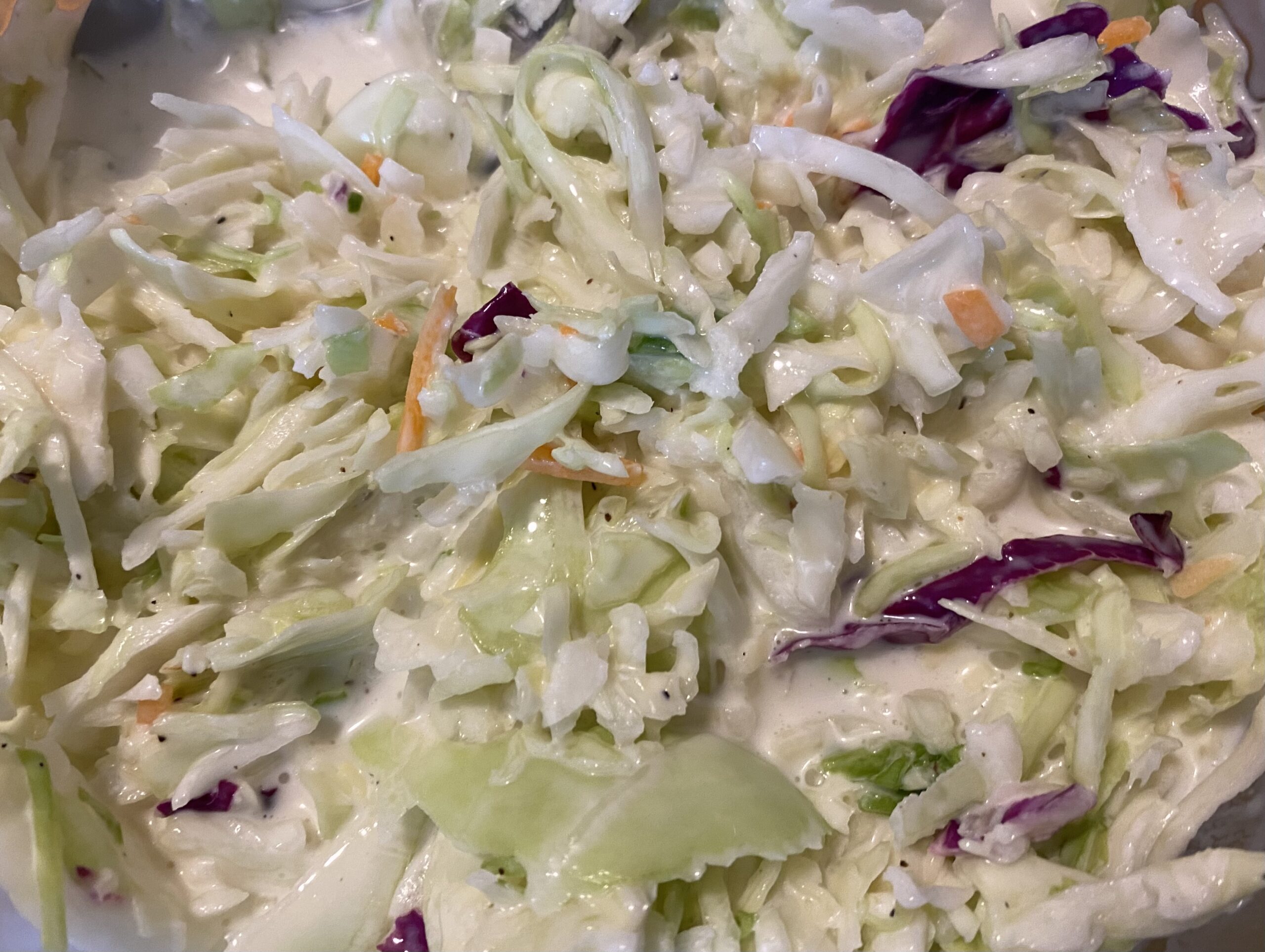
Fish and chips go perfectly with fresh coleslaw, tarter sauce and cocktail sauce. Here are out favorite recipes for those sides and dipping sauces.
While this recipe is perfect for lingcod, rockfish or halibut, it also works great for albacore tuna, and isn’t bad for salmon, either.
Cut fish into smaller pieces, pat dry with paper towels, and season with salt and pepper.Flour, rice flour, baking powder and turmeric.Stir the dry ingredients, beer and vodka together until any large clumps are gone.Fry with at 400 degrees for 3-5 minutes.Drain on a wire rack over a baking sheet for crispy, not soggy, fish and chips.Perfectly cook fish and chips.
Perfect Beer Batter
1-2 pounds fresh white fish (rockfish, lingcod or halibut)
Vegetable or peanut oil (enough to full cover the bottom of the pan and fish)
Salt and pepper, to taste
1 cup all-purpose flour
1 cup white rice flour
1 1/2 cups chilled beer
1/2 cup vodka
2 tsp baking power
1/2 tsp turmeric
Heat oil to 400 degrees.
Cut fish fillets into smaller pieces, pat dry with paper towels and season with sea salt and pepper.
In a large bowl, combine all-purpose and rice flour, turmeric and baking powder and whisk together. Stir in beer and vodka, stirring until any large clumps are gone.
Add three or four pieces of fish at a time to batter, stir to completely coat. Remove one piece of fish at a time from batter, making sure it is thinly coated. Allow excess batter to drip off, or gently scrape excess batter on the inside of the bowl.
Fry three to four pieces at a time in hot oil, until crispy and golden brown, usually 3 to 5 minutes. Remove fish from oil and place on wire rack placed over a baking sheet to drain.
Serve with cocktail and tarter sauce, and lemon wedges.
To catch a limit of rockfish or lingcod to try with this recipe, visit www.brookingsfishing.com, or call (541) 813-1082.
Deckhand Eric Howard with a nice lingcod.A happy customer with a trophy vermillion rockfish.
BROOKINGS, Ore. (July 20, 2024) – Pacific halibut – which average around 20 pounds but can sometimes top 100 pounds – are showing up in greater numbers off the coast of Brookings, as the peak season arrives on the Southern Oregon Coast. Halibut season opened May 1 coastwide, but out of Brookings, late July, August and September produce the best catch rates. Fishing has improved the past two weeks out of Brookings.
A nice catch of halibut caught aboard the Dash with Capt. Mick in July 2024.
Halibut migrate to deep water in the Gulf of Alaska to spawn in the winter, and move back into shallower water during the summer to feed. On the northern Oregon Coast, halibut are within range of the sport fleet early in the season. Out of Brookings, where anglers like to fish in 200 to 250 feet of water, the best fishing takes place later in the season, as the halibut finally move inshore. By October, the halibut are back on the move into deeper water.
Fish on! Customers aboard the Miss Brooke reel in halibut.
The Brookings Fishing Charters crew has been catching halibut recently on long-range trips to specifically fish for them. A customer on the Miss Brooke landed a 54-pound halibut on July 19. Most of the halibut have been closer to 20 pounds. The fish are being caught using combinations of herring, salmon and squid, using custom leaders developed by Capt. Andy and Capt. Rye, who spent years running halibut charters in Alaska.
Deckhand Eric holds a 54-pound halibut caught on the Miss Brooke.
The Brookings Fishing Charters crew uses techniques similar to Alaska charter boats, anchoring and fishing a variety of baits, using the current to bring the scent to the halibut. The catch rates for the Brookings Fishing Charters crew are the highest in the harbor.
Capt. Andy holds a halibut caught aboard the Miss Brooke in July 2024.
Halibut season runs through October. Trips are offered daily during calm weather periods. To learn more, visit www.brookingsfishing.com, or call (541) 813-1082.